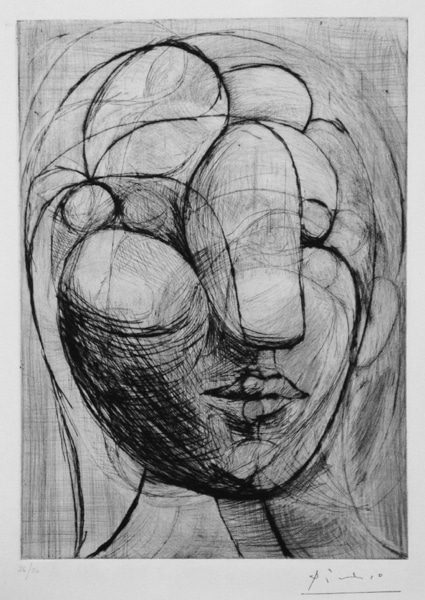
I guess it paid off to stick it in their evening sale. Yes, folks, last night’s La femme qui pleure, I at Christie’s NY went for $5,122,500, thereby setting the world’s record for a print by any artist. It also more than doubled the previous record for a Picasso print at auction, an unsigned impression of La Minotauromachie at just under $2M last year in London. Wait just a minute—I have to stop and catch my breath….
Birthday Greetings
Yesterday marked Picasso’s 130th birthday. Hard to imagine that the quintessentially modern artist lived so long ago! Included in our collection is a Blue Period drawing that is shockingly over a century old—a veritable antique. Happy birthday, Pablo!
What’s on the Block
There are some nice offerings at the fall auctions in NY, but before we get to the paintings, it is noteworthy that for the first time, at least of which I’m aware, prints have made one of the storied evening sales. Both their low estimates exceed the million $ barrier, and both are at Christie’s, consisting of an unsigned Minotauromachie and a signed impression of La Femme qui Pleure, I (Bl.1333), the final (7th) state:

What’s even more remarkable, it seems to me, is the unusually large number of really nice paintings, eleven in the Christie’s evening sale alone.
At Sotheby’s, there’s the fascinating 1927 Guitare accroché au mur:
and the huge late Picasso painting, one of the nicer ones, L’Aubade (The Dawn Serenade, 1967):
At Christie’s (in chronological order), there’s the small 1919-20 Guéridon devant une fenêtre aux volets fermés:
a serviceable Marie-Therese, the 1935 Femme endormie:
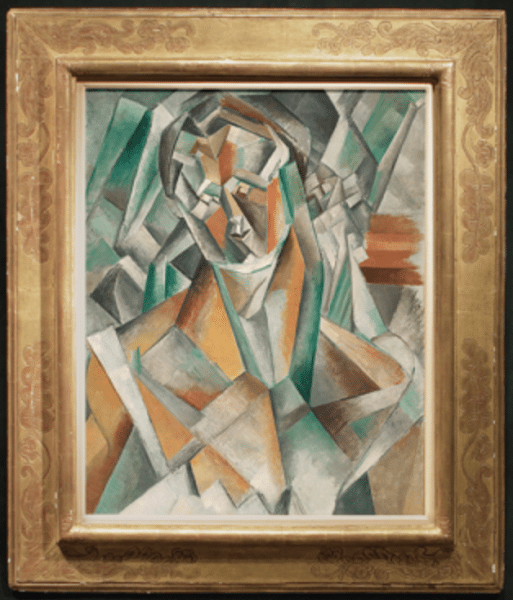
a decent Dora, the 1938 Femme assise:
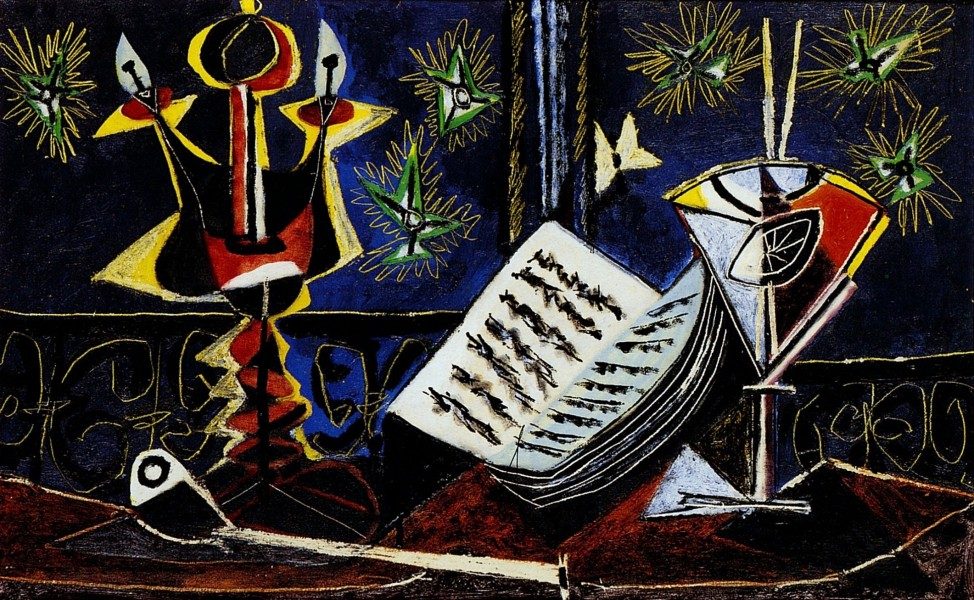
a very nice still life, more colorful than many wartime images, the 1944 Citrons et verre:
a good animal combat, the 1965 Homard et chat sur la plage:
and, last, the 1968 Mousquetaire buste, an amusing piece and a good value for the money:
There are also a couple of wonderful, full-sized drawings, one at Christie’s, the 1938 Figure féminine assise:
the other at Sotheby’s, the 1969 Homme au turban et nu couché, (PP69.399, catalogue # misprinted in their ecatalogue):
Let the games begin!
Picasso Orphans

1962 Deux vieux lisant une lettre (click to enlarge)
Earlier today, while shelving some recent auction catalogues, I started leafing through one of them to the dog-eared pages which marked the Picassos, when a wonderful drawing hit me again. Now don’t call me a grumpy old man, but I find it surprising when every now and then a great work falls through the cracks and the art market doesn’t notice. Take these two old men. Sure, this is not a drawing of a woman, much less a naked woman, and it doesn’t have a drop of color. It’s not large (but at 35 cm, not that small either) and it’s not an oil, just a lowly pencil and paper. But this picture has so much heart, it’s so well drawn, and so amusing that I can’t believe it was bought in.
True, there’s nothing sexy about these two old men. But one of Picasso’s most endearing qualities is that along with the mythical and heroic, he portrayed many mundane subjects and there, by the masterful stroke of his pencil, transformed them into the mythical and heroic (see “The Water IS the Wine”).
Take a look at the wizened old man on the left with his funny hat. I like the way his beard blends into his cloak, as if the whole figure were carved from wood, or of melted wax. It’s interesting how the viewer’s eye even reads it as a beard, mostly I think because it must be a beard that’s hiding the mouth. The aging clown is also priceless, and the singe line that depicts both eyebrows, forehead and hair is a tour de force. I also like the shorthand by which Picasso depicts the object (a candelabra?) in the background. And did you notice the figure in the doorway (or is it a painting?) carrying a tray of tea, an allusion to the servant in the background of Picasso’s 1955 series, “Les Femmes d’Alger”:
You can have your slapdash 5 and 10 million dollar late Picasso oils, which are now all the rage (I, too, love the great ones, but there were many silly products which nonetheless command staggering prices)–I’d sooner take this late Picasso drawing at around 2% of their cost. OK, so it’s not the kind of artwork that will “hold the wall”, i.e., it can’t be readily resolved from across a large room, but that’s factored into the price. And don’t tell me it didn’t sell because it wasn’t signed!
Jerry Won!
The “Ledor Gallery Race Car”, courtesy of driver/owner Jerry Kroll, propelled by dachshund power, just won the 2011 Sports Club of America (SCCA) Championship for Formula Enterprise. Go Jerry!
It is impossible to fully appreciate the breadth and depth of Picasso’s art without pouring through his catalogues raisonnés (the tomes that illustrate all of his known artworks). Visiting the Picasso Museum in Paris is as close as one can come to achieving this goal by looking at the actual art. The traveling loan from that museum at the de Young includes many masterpieces but is still a very small sample of his work. It’s about as representative as 150 of his artworks could be, but he created so many varied styles and subjects that they couldn’t be included in any depth, or some of them included at all, in a show of this size. The exemplars of the Blue and Rose Periods are quite lean, Cubism is narrowly surveyed, the entire decade with Françoise is represented by only four drawings and prints, and Late Picasso gets short shrift. By contrast, 150 works of any other artist, or even 15 works, would give you a pretty good idea of what that artist was about. The de Young exhibit makes a noble effort at taking the measure of the man, and it scores many points by including a proportionate number of drawings and prints and a disproportionately large number of sculptures, rather than just paintings. But in the end, thoroughness remains an unattainable goal. The Picasso Museum in Paris with its vast collection has the best shot at it. The only temporary exhibit that ever came close was the 1980 Picasso retrospective at the MOMA, but it had a 1000 Picassos on view. (A show of that scale is never to be repeated.) We Picasso lovers make do with what we can: we see his work piecemeal in various museums, and we rely upon illustrations in books and websites to flesh out our understanding. And every now and then we have the good fortune to see a Picasso exhibit that examines a single period in depth.
This realization, that only the Musée Picasso comes close to doing Picasso justice, is one step along the path to the inevitable conclusion that Picasso is the greatest artist of all time. The staggering number of his styles through which he alternately reflected and distorted reality, and the complexity (or deceptive simplicity) and the masterfulness of each of them bear witness to his unparalleled imagination and establish his supremacy. Van Gogh was a great artist, but how many styles did he have? Basically, one. The mature Gauguin? One. Manet? One. Monet? One, one-and-a-half. Matisse? I’d pretty much call it two. Miró? I haven’t counted, but let’s grant him several. Each of the pre-Moderns? Certainly just one.
The third argument for Picasso’s supremacy is his graphic mastery, which was at least as good as any of his predecessors (and certainly no one has challenged it since). Not that you need to know how to draw anymore to be a competent artist today. Abstraction is how contemporary art has sidelined drawing, but Picasso for the most part avoided it (though you’ll see one painting in the exhibit that foreshadowed abstract art). He didn’t need abstraction, and it would have been insufficient to convey his complex vision, unlike his unfailing line.
Picasso in Exile
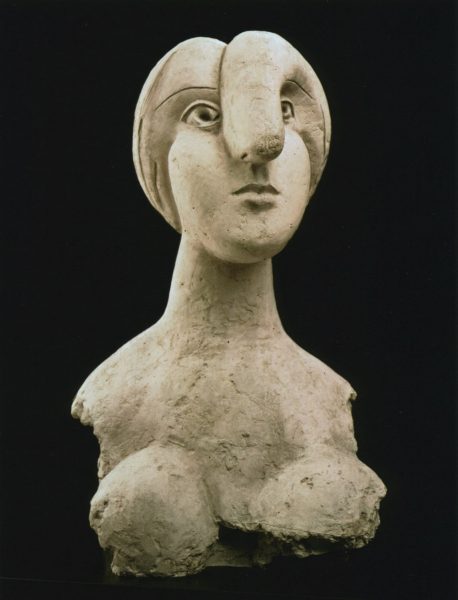
Why bother visiting Paris, you might ask, as long as the Picasso Museum remains closed? Good question. But my family and I decided to go anyway, unwilling to wait another year. Our Picasso treasure hunt therefore required a little extra work, since you couldn’t very well go to just one place and be greeted by Picasso’s many persons and things. Our first Picasso sighting was just a fortunate accident–while strolling near our flat, my wife Casey spotted a wonderful, if bird-stained, bronze of Dora Maar in a small garden in the shadow of the gothic Church of St. Germain des Prés (located at its eponymous square):

Tête de femme, aka
Monument à Guillaume Apollinaire
This wartime sculpture (1941) was chosen by committee to honor Guillaume Apollinaire, the famous French poet and prominent member of “La Bande au Picasso” (Picasso’s wolf pack) dating from his early Bateau Lavoir days in Paris. Apollinaire had died in 1918 of a head-wound incurred in during WWI. A decade later, his widow and others anointed Picasso to create a suitable monument to honor him. The problem was that they rejected one submission after another, until finally Picasso presented them with this handsome but rather bland sculpture, at least in comparison to the more radical pieces he had previously proposed. After decades of haggling, the committee in its infinite wisdom finally accepted this portrait of Dora Maar. To provide a sense of the value of this Picasso that we randomly stumbled upon, another cast of this sculpture (there are a total of four) fetched a bit over $29M at Sotheby’s NY in 2007. The value of these pieces is presumably well known, as the bronze at St. Germain was once stolen from the site and subsequently recovered two years later. I trust it is now more firmly anchored to its limestone base….
Venturing across the river, we took in the Picassos at the Beaubourg (Centre Pompidou) and a few of the galleries on both sides. For the most part, that was it for our adventures with Picassos in Paris, other than one lovely drawing discovery that will hopefully soon be available (pending authentication by Maya or Claude). The rest of our Picasso adventures would more accurately be described as misadventures, beginning with UNESCO. Having not come even close to satisfying my thirst for Picassos, this trip we finally got around to going to the UNESCO headquarters near Napolean’s Tomb to see the huge Fall of Icarus mural:

La Chute d’Icare
The Fall of Icarus
Curiously, there were no signs of recognition on the part of a number of attendants. No one seemed to know that, at over 10 meters, one of the largest Picassos ever was on their premises. Finally, one of them delivered the news that such viewings have to be arranged in advance. It was our last day in Paris, so we were out of luck, but maybe you’d fare better with a bit of preplanning. Or just wait till the Musée Picasso reopens next year. Or see its generous loan to the de Young Museum in San Francisco this summer!
Scam, or Not? You be the judge….
To add to the ever-increasing list of art scams comes this story, which distinguishes itself with its novel, dramatic flair. I should say “possible” art scams, since this one remains unproved. As you know, usually I write only about Picasso, but this tale seemed so unusual that it grabbed my attention. How about I lay bare the story and you could be the judge?
About a month ago, on a fine spring morning, two friends of mine, a well-heeled Bay Area couple on a jaunt to NY, stumbled into a Chelsea gallery, where an installation of works on paper by a Japanese artist was being hung. They fell in love with two of the artworks, each measuring around 2 x 1.5 ft., asked for the prices ($2500 each), negotiated a combined price of $4000, and paid. Since the show was in the midst of installation, they inquired whether the artist was around because they wanted to meet him. The gallery owner said that artist had stepped out but would call them upon his returned. Having received the call, they reappeared at the gallery, only to be beset by the artist’s distraught wife, who cried that the price of each work was actually $25,000. The gallery owner said that the art belonged to the purchasers, but hopefully my friends would do “the right thing”. They said they’d think about it. A day or two later, they phoned the gallery and offered a total payment of $8000. The owner said he would consider the offer and later accepted it.
In the meantime, my friends Googled the artist and found nothing. This was apparently his first show, or at least his first show in the US. My interest was piqued because $25,000 seemed an unusually high sum for an undistinguished work on paper of this size by an unknown artist in an obscure gallery.
I haven’t yet described the obscurity of the gallery. I’ll let you read my friend and fellow collector’s words, whom I sicced on them, or I should say, who graciously did me the favor of investigating. Here’s his take (I’ve substituted Gallery X for the gallery’s name and Artist X for the artist’s name in his narrative):
“Most Chelsea galleries are closed weekends in the summer, as jet setters leave for the Hamptons. (I believe a few galleries open outposts there.) That said, the larger ones are open. So I assumed between Gagosian being large and almost more of a museum, it would be open. Apparently I was wrong. Very upsetting. Gallery X, however, was open, which was a bit surprising. How your friends found this gallery is anyone’s guess. It was tucked way back in a warehouse gallery building on the third floor. I do not mean this all to sound snobbish (as I think most store fronts are likely to rob you) but this gallery was just very off the beaten path. I went in and a white haired man, who felt like the proprietor (though I did not ask), seemed somewhat surprised when I asked about Artist X. He said they “have shown his work” when I asked if they were his dealer, but he had no information on him. Note he is not one of the artists on their website now. He did not volunteer any information about the artist (or even bother trying to push me towards something else). I gave him my email, and he may send me some stuff but who knows. I looked around a bit at other art in the gallery. None of it my thing but interestingly, all well under $5K for most pieces (and a lot close to $1K). It would seem very odd for a gallery representing artists (there were maybe 10 on display) at that price point to then show an artist that much pricier, but maybe it was a special show. But why would an artist of that level hold a special show at a gallery that is so far out of the way and has clients at a different (albeit not massively different) price point? Anyway, certainly nothing conclusive but still a bit odd. Let’s see if he sends me any pieces they have for sale.”
It’s been a week. Still waiting for a price list from Gallery X. I suppose it could still arrive. In the meantime, what do you think: scam, or not? Have you ever heard of such a thing?
WHAT’S NOT THERE
The Picasso Museum on wheels, currently at the de Young in San Francisco, is such a wonderful show (see “Picasso by the Bay” below) that it’s almost easier to discuss what’s not there than what is. Well not quite, though each great Picasso, in addition to being loved and understood on its own merits, must be seen in the context of his entire oeuvre for full appreciation, given the added dimensions that the context inevitably provides. I won’t again trot out the by now overused Picasso-ism about the movement of his thought interesting him (in his later years) more than the thought itself–there, I said it anyway. But nowhere is that movement better preserved, with the exception of the successive photos of Guernica and The Charnel House, courtesy of Dora Maar, than through the window of the progressive states of so many of his prints. And every now and then, a certain Picasso, in this case a drypoint from 1933, veritably screams out for its context. The case in point looks more or less like this:
interesting enough perhaps when seen in isolation, but nothing compared to when it’s in the company of its friends. You see, this print is the XIVth state of twenty! (Or XIIIth. I have to go take another peek at it, now that I’ve looked up all the states in the catalogue raisonné.) The subject of this print went through so many phases, not the least of which is that she started out as a profile facing (our) left, then assumed a quarter face pose, then straight on, and finally ended up a quarter face turned the other way. You’ll see a few of them (below), but for the whole set, you’d have to consult Baer Geiser, Vol. II, No. 288. What’s so great about the progression is that, except for one major erasure between states 7 and 8, Picasso doesn’t cover his tracks, but leaves a trail just clear enough to show us where he’s been. The technical term is pentimenti, but never mind. I won’t even bring up “palimpsests”. Except to say that this may well be the most fascinating of all of his many palimpsests. Oh, no, I did it again. Anyway, it’s tragic that he didn’t print more, many more, than the unique impression of each of the states IV through VII, because they are all masterpieces. He pretty much started over with state VIII for some unknown reason, and, from there, fooled around for a while without dropping any clues as to where he was headed or whether he could possibly save this progression from disaster, or so it might at first seem, all the way up through the penultimate state–well, there were already some hints of masterpieces in the XVIIIth and XIXth states, but, suddenly and almost without warning, voila! the XXth and final woman (ref. Bloch 250) emerges, as if from a cake, and becomes one of the most wonderful and intriguing of all of Picasso’s graphic works. You really need Baer Geiser for a full appreciation of the continuum, but here are photos of some of the states, just to get you started:
From humble beginnings, State I:
comes the transfixing States V:
and VII:
Then he takes it all away by State VIII, and starts rebuilding slowly with State IX:
and brings it all back by the XXth and final state:
By the way, if you bought the catalogue, you won’t find this print illustrated within it. You might also have noticed that there are many more illustrations there than exhibited artworks. Although works in other mediums have remained constant (or nearly so) at all the exhibit venues, the print selections have varied greatly. So it is with this state XIV or whichever, temporarily orphaned, but soon to rejoin its dark family berth once again in some hallowed print file in the Musée Picasso’s basement. Pity. Anyway, be sure to spot this intermediate state if you make it there–it’s sojourn in San Francisco may well be its last sighting ever!
Picasso by the Bay
San Francisco is so awash in Picasso this summer that I feel like I never left New York. First the Steins’ Picassos, then the de Young, last night Woody Alan (pleasant fluff, but what a one-dimensional Picasso, though I suppose Woody may not have needed any more dimensions in the service of his film), and we haven’t yet even gotten to the ceramics show at the Legion of Honor. The Steins Collect show at the SFMOMA is quite wonderful (ending Sept. 6; see above), but since it trails off near the beginning of Synthetic Cubism (when Picassos grew too dear for the Steins’ budget), it is good preparation for the de Young Museum exhibit: Picasso: Masterpieces from the Musée National Picasso, Paris (till October 9). The Picasso Museum is closed for renovation till next year (among other things, they’re increasing their exhibition space by 50%–yay!), so they sent packing some 150 artworks on an international junket, first to the Seattle Art Museum, then the Virginia Museum of Fine Arts, and now to our fair city.
Picasso liked to say that he was his own greatest collector, and that he certainly was, having kept over half of his output until the end of his life. His heirs thankfully paid his inheritance taxes with art, thereby endowing France with the single largest collection of Picassos in the world. (I have read that it initially numbered 3500 works and has grown through purchases and bequests to 5000, though even the latter seems like too small a number, given the Picasso Museum’s vast print collection. I’ve had the impression that the museum has a nearly complete print collection, which alone would comprise around 2500 works, not to mention the many rare states of many of those prints. The absence of solid numbers runs deeper. Weirdly, even estimates of the total number of his creations varies widely, from 35,000 to 50,000. Alan Wofsy, the San Francisco art publisher who updated Zervos, Picasso’s catalogue raisonné of all his works except his prints, told me that his volumes include 35% more works than Zervos. Perhaps that accounts for much of the wide gulf between 35,000 and 50,000. Clearly I’m in desperate need of a fact checker–like everyone else, I guess I’m too busy gawking at the art to obsess over the statistics.)
I have often read that the French Government and the art historians in its service did not know what they were doing when choosing the artworks from Picasso’s estate. Any visit to the Musée Picasso Paris would seem to prove the contrary, since in my opinion (I would say this!), it is the most magical and marvelous interior of any building in the world. The Picasso Museum’s traveling exhibit should alone be convincing enough. There are loans and there are loans. Loans are of course telling about the generosity of the lender, and, in this case, the Picasso Museum emerges as spectacularly generous. Unlike the Stein collection, which includes many wonderful Picassos but few great masterpieces (at least in comparison to the remainder of his oeuvre–the Steins’ means were limited, after all), the de Young exhibit is an onslaught of masterpieces. One walks through the galleries in utter disbelief amidst the frontal assault of one incredibly, impossibly great work of art after another. Go there, but plan ahead–tickets will likely sell out (even for members)!