06.09.10 | add comment  

He’s Back!

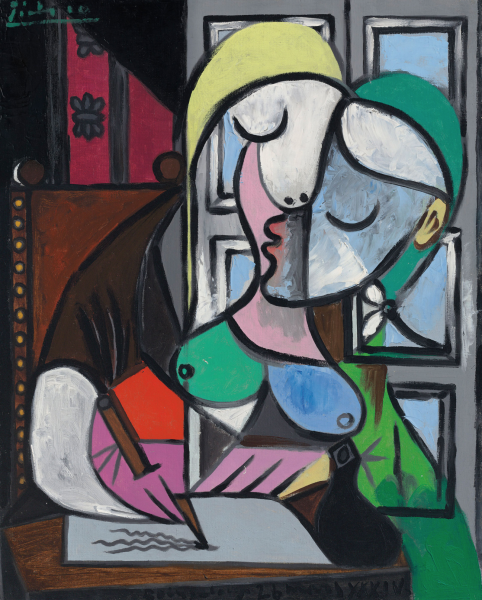
He’s back!  Four years and one lawsuit later, the angel has descended again.  This portrait is, I’m convinced, the best Blue Period painting not yet in a museum, and one of the best of all.   If I had a cool hundred mil to blow, I would have held my fire when the Marie-Therese was up last month and would have set my sights on him.  She’s not the best Marie-Therese by a long shot, but she was available, and I suppose you gotta love the one you’re with.  Or not.

The Portrait de Angel Fernandez de Soto is such a powerful work.  I stood transfixed before it  for quite a while four years ago and regret that I won’t be traveling to see it in London before it disappears once again.  Back then, I predicted here that this painting would set a new world’s record.  Never shy of walking out on a limb, I’ll do so again now.  He may not be as colorful nor as sexy as the Marie-Therese, but lately the market has seemed pretty sophisticated and will hopefully value this painting appropriately.

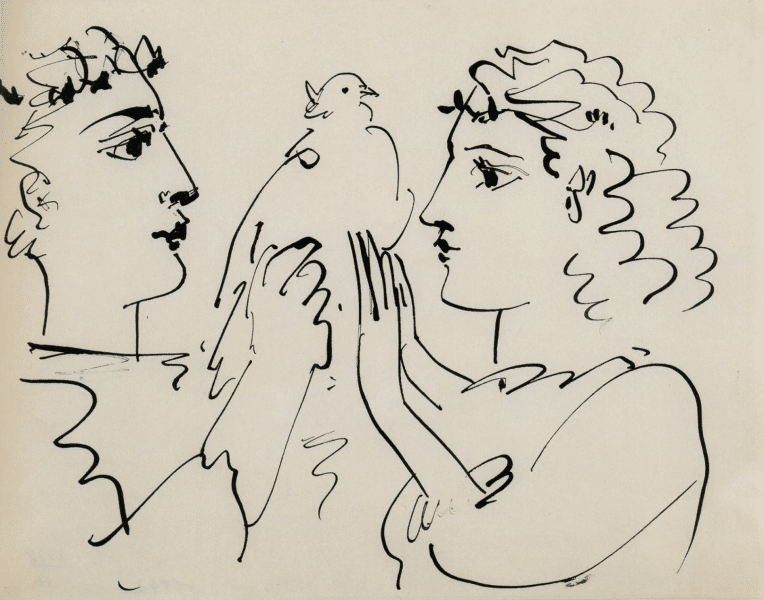
What do I mean by “sophisticated”?  Simply the ability of the buyer to look beyond size, color, and superficial “prettiness” to the real beauty (and importance) of the work.  A good example of this is the 1933 smallish inkwash (22.6 x 28.7 cm, 8 7/7/8 x 11 1/4”) entitled  Le repos du sculpteur that just sold at Sotheby’s Paris for 3,760,750 euro (4,572,311 USD), at about five times its high estimate I might add:

Christie’s has a long and excellent discussion of the Angel de Soto in its catalogue.  The best part of it is arguably the quote from John Richardson, which I’ll reproduce here:

“The portraits that Picasso did of his closest friends, Angel de Soto and Sabartés, in the course of his last months in Barcelona delve far more deeply into character and take far greater liberties….  The deformations in the Soto portrait–the jug ear, skewed mouth, prognathous chin–seem caricatural, but the image transcends caricature.  By this time Picasso had learned how to exploit his inherent gift for caricature in depth as a means of dramatizing psychological as well as physiognomic traits.  Whereas the average caricaturist externalizes things and comes up with an image that is slick and trite–an  instant cliché–Picasso internalizes things and comes up with an enhanced characterization of his subject.  Picasso enlarges Angel’s heavy-lidded eyes out of all proportion and endows them with his own obsidian stare.  Among his immediate predecessors, only van Gogh had this ability to galvanize a portrait with his own psychic energy.” (J. Richardson, A Life of Picasso: Volume I: 1881-1906, London, 1991, pp. 285-86).

Full disclosure: I have nothing to disclose.  I only wish I were able to influence the course of the sale of this Blue Period masterpiece!

add comment

I’m often asked about my opinion of art as investment.  My opinion, whatever it is, is presumably clouded by my love for Picasso.  Better to direct such inquiries to the Mei Moses® Fine Art Index  (artasanasset.com), a statistical database and analysis compiled by two NYU economists.  Quite sensibly, they limit their statistics only to auctioned works (so that the facts of the sale are in the public domain and known beyond any doubt) and further limit their stats to those works that have sold at auction more than once.  They compare only the prices achieved at auction for two or more sales of the same artwork.  The advantage is immediately evident: they’re comparing only like commodities.  More than like—identical.  It would be much less meaningful if they were comparing different artworks to each other.  Unique works are by definition different one from another, and many of the differences are not quantifiable.  But with their methodology, Mei and Moses have eliminated subjectivity.

Feel free to wade through their site, but, in a nutshell, here’s what they say:

“…over the last fifty years the Mei Moses® all art index and the S&P 500 total return stock index have had approximately equal compound annual returns. The art index has underperformed the equity index for the last 25 years. Over the last five and ten year periods art has significantly outperformed equities. However for almost all these time periods art has higher volatility and lower liquidity than most other financial assets. However art has low correlation with other assets and thus may play a role in portfolio diversification.

“The 2008 decrease in the return of the all art index of almost 4.5 percent is the first time our all art index has declined after five years of positive annual growth averaging almost 20 percent. This result dramatically out-paced the 37 percent decrease in the S&P 500 total return index…for 2008.“

I would add, don’t bring it home if you don’t love it.

add comment

Hani Shihada, Madison Avenue, April 28, 2010

It’s springtime in New York, and Picassos, like bulbs, are flowering everywhere.  It was truly a pleasure to soak them in at the museums, the auctions, and also at Marlborough Gallery, which had staged an impressive print exhibit, including the masterpieces from the Nelson Blitz and Catherine Woodard collection.   It was also a relief that Giacometti was bloodlessly deposed, after his brief and inexplicable reign.

Curiously, I found myself defending the Met’s exhibit, primarily from charges that the show was long on early works but short on the rest.  The NY Times was in the vanguard of this innuendo, but more than one of my friends followed its lead.  It seemed to me to say more about human nature—you know, attacking whomever is at the top—than the quality of the exhibit.  So what if the Met’s collection is spotty?  Museums take what they can get.  No museum has the billions it would take to amass a more thorough Picasso collection today.  As for me, basking in the glow of just one, any one, of the many Picasso masterpieces at the exhibit would have been enough to make my week.

Regarding one of them, I had a running controversy with some of my friends as to which is the better painting, the new auction queen, Marie-Therese asleep indoors, or the Met’s smaller work, Marie-Therese asleep outdoors:


The Dreamer (1932), Metropolitan Museum

Marie-Therese, for one, certainly didn’t seem to care, lost in the rapture of repose in both canvases.  And I didn’t want to depress the bidding by showing my hand before the auction (as if!), but now I can come clean.  Sure, the Brody painting is more complex, with Marie-Therese’s sculpture and the artist’s silhouette in the background, and the houseplant is more beautifully realized than the flora outside, but, at the Met, her flowing curves stole my heart.


Hani Shihada, Madison Avenue, April 29, 2010

add comment

04.02.10 | add comment  

Fading

I’ve belatedly considered that it might be useful to indicate here when I’ve updated any of the Collecting Guides.  Well, perhaps you might like to know that  I’ve just expanded the discussion on the fading of prints, which you could find in the “Collecting Pitfalls” chapter of The Guide to Collecting Picasso’s Prints, just a little ways down from the top….

add comment

“The more I see, the less I know.” – Michael Franti

Weeks have passed, but I still can’t seem to get my mind around Giacometti’s 100 million dollar man.  A 104.3, to be exact.  (As you may have guessed, I didn’t have the same mental block when it came to Picasso’s 100 million dollar boy.)  I thought I liked Alberto Giacometti as much as the next guy, but I guess I was wrong.  He made some wonderful sculptures, but, at 100 million dollars, not to mention his other recent stratospheric prices, I am forced to conclude that he is an amazingly overrated artist.  And this sculpture was not even close to one of his best, as far as I’m concerned.  It’s also not unique—the edition size is 10—which fact I bring up only because scarcity is an inescapable determinant of value.  (Though this is not a bad time to remind those of you who still consider the term “print” pejorative that bronzes are often also not unique and are no closer than prints to the artist’s hand.)

Auction prices such as this (and other examples abound) reinforce my deeply held conviction that Picasso is comparatively still very undervalued.  For instance, take Picasso’s bronze La guenon et son petit:

To my eye, it ought to be worth 100 times Giacometti’s Walking Man. That would make it worth what—10 billion dollars?  Sounds about right to me.  And to think that these mother and child chimps fetched under 7 million US in 2002.  Proving that, as an economist client of mine puts it, the art market is in a state of disequilibrium.  I’ll say!

As for me, I think I’ll stick to collecting Picasso, not only for the beauty of his works, but also because he is still quite undervalued.  I also think I’ll make my own Giacometti…topiary, that is, after one of  his works that I vastly prefer to his Walking Man:

I intend to use a weeping Blue Atlas Cedar or two to sculpt my Giaco pup.  What do you think?  Here’s a specimen that looks like it’s already halfway there:

add comment

1955, @ belly painting, close-up

Femme au chapeau, @ 1955

This lovely Picasso is courtesy of a Picasso lover and aspiring collector, who writes, “Just to give you a bit more background from my end, my wife is a sculptor and we obviously have a shared interest in art. I’ve become fascinated by Picasso over the years, and owning a print has been a longstanding ambition.

“There’s also a family connection – my father and a friend spent a week with Picasso in the south of France in (I believe) 1955.   As I understand it, the friend (Ernest Asher) knew Picasso – he may have been his dentist. As my father told it, they got on very well; my father (then and later) didn’t understand and had no interest in Picasso’s art, and my sense is that by this time Picasso may have been relieved to spend time with someone who wasn’t a fan!  My father brought back a number of photos….  My Dad is the one with dark hair; Ernest Asher has the Picasso original on his stomach; and the child on the seesaw is Paloma….  Picasso gave my father the [ceramic] plate, which I’ve inherited…shown on display in another of the photographs.”

What would you have done if this fate befell your belly?  I fear I could never have bathed again for the rest of my life!  Nor removed Paloma’s float from my neck, as it crowns the portrait with a hat.  Maybe it’s good I never had a chance to meet Picasso—for hygiene’s sake….

add comment

In view of the chap who just pled guilty to selling fake Picassos on eBay (see, for example, yesterday’s NY Times online article, “Chicago Man Admits He Sold Bogus Picassos on eBay”, which begins as follows, “A suburban Chicago man pleaded guilty Tuesday to swindling at least 250 people out of more than $1 million through the sale of counterfeit prints advertised as the work of Pablo Picasso and other major contemporary artists”, I thought I’d post an exchange I had with another eBay seller some time ago, as follows, beginning with the email that first drew me in.  (This is a long exchange rife with more detail than you might wish.  But, if you don’t mind my saying so, whenever you’re considering a purchase, this is the kind of detail your due diligence ought to unearth.)

anatomy of an art fraud on eBay

Dear Kobi, How fortunate for me to come across your Forum.  I was actually considering bidding on a “hand-signed PICASSO with Certificate and Provenance” this evening.  If you’re interested in viewing the listing that almost had me, it is eBay #________.  I suspect most individuals wouldn’t have taken the time to do some basic online fact checking.  The paper size is indeed different from the one listed at the Picasso Project as you suggest.  There is a small fortune changing hands just in the pursuit of a signed print from the Vollard Suite on eBay.  Imagine the amount for all Picasso’s!  With sincere gratitude, Richard

Dear Richard, Actually, this episode is so funny that it’s worth blogging.  Bolliger published a book in Germany in 1956 of the identical dimensions as stated on eBay for the print for sale.  It seems that the seller just tore a page out of Bolliger!  The only thing I can’t account for is the missing page number….  Best wishes, Kobi

At this point (this is Kobi speaking), I sent the following message to the seller, and the following interchange ensued:

Q: Are you aware that this print is not an original print by Picasso? The original was an etching of a different size than you describe. I believe your print was torn out of Bolliger’s book, which dimensions it fits perfectly. Did you know that? Thanks

A: This print was not torn out of Bolliger’s book. I have his book and I can tell the difference. For one thing the type and weight of the paper is radically different. I never implied that this was from a first original edition which, if signed, would list for over $10,000. However, I’m happy to exchange any form of information which you desire about the artist, his publisher, his printers, and his editions. Thank you for your email.

Q: I am an expert in Picasso prints.  You should be aware that there is no “original” German edition, as some fraudsters have claimed.  In fact, there is no original edition of any Vollard Suite prints other than the impressions published by Vollard.  Any other editions are not original in any sense of the term, as they were not created by Picasso in any direct way, other than someone reproducing his design.  Are you aware of the accuracy of all of my assertions?  Finally, are you aware that the signature is forged?

A: Please send me your name and credentials. I would like to further discuss this with you. I am not trying to be antagonistic when I pose this question back to you: Are you, kobiledor, aware that Vollard published none of the so-called Vollard Suite prints? He died shortly after Picasso completed the commission. The copper plates were never printed to paper before 1950. And then, they had been sold to separate parties (not printed by the Vollard estate.)  I have a lot more information on this which is verifiable in a number of the most impeccable art history reference books. However, I do understand that even textbooks can have erroneous entries. So, please share your sources of information with me which support your assertations [sic].  I disagree that the signature is forged. I have addressed your other assertations [sic] in a direct response to the email which was sent from you separately. Before we continue this dialogue, which consists mainly, as I see it, of hostile accusations, I would like to know who you are and specifically what your credentials are.

Q: I do not intend my questions to be laced with hostility.  I am simply in favor of honesty in the marketplace.  My credentials are that I have studied and collected Picasso and particularly his prints for many years, and I own a nearly exhaustive library consisting of all his important catalogues raisonées.  Again, I mean no offense, but your last two emails are rife with misinformation.  What is not entirely clear to me is whether this results from your honest mistakes or  an actual intention to misinform.  On the chance that you intend to misinform your clients, I would prefer not to further address your factual errors for fear that you would accordingly adapt your captions in order to further mask the lack of originality of your offerings.  If, on the other hand, you are honestly in search of an education in order that your allegations stick closer to the truth, please then prove your intentions to me, and then I’ll be happy to reconsider sharing the facts with you.  Please note that eBay classifies your Vollard as an original hand-signed Picasso in its first line.  It is none of these things.  In order to be an honest dealer, it is incumbent upon you to accurately describe who and how made your print.  To say that its provenance is directly traceable to Picasso is ludicrous.  I only can hope that the many mistakes you have made are honest ones, but your choice of words and phrases seem so crafty as to make me fear the worst.  Please pardon me if I have misjudged you, but I tend to doubt it.  Best wishes.

That was the end of the correspondence. 

The following is the eBay listing, with the identity of the seller omitted, and with my italicized annotations:

Listed in category:Art > Prints > Contemporary (1950-Now) > Limited Editions > Original Hand-signed PICASSO with Certificate and Provenance
Comment: Here is the first mention that the print is “original”, though just below, note that the vendor left blank the “Original/Repro” question that eBay poses.

NO RESERVE – Beautiful Framing worth $500+
Type: Modern – Limited Edition
Signed?: Signed
Comment: The signature is a forgery.  Not only does it not resemble any of Picasso’s signatures, but the only prints of the Vollard Suite which were signed in red, 3 impressions out of a total edition including all artist’s proofs, of 321, were printed on parchment.

Medium: Lithograph
Comment: None of the original prints of The Vollard Suite were lithographs.  Every one was an intaglio print, usually an etching. Any other print depicting a Vollard Suite image is a worthless fake with a forged signature.

Original/Repro: — [left blank]
  No Reserve!  
This is the last lithograph that I have from this limited edition.  All of the others have been sold.  This is one of Picasso’s most treasured lithographs made from the Vollard Suite etchings (plate #79).  A wonderful collector’s item with Certificate of Authenticity from the original gallery and Provenance going back to Picasso.
Comment: COA’s aren’t worth the paper they’re printed on, if you don’t know and trust their author, and the provenance is untrue, as this fake could not have gone back to Picasso, as he had nothing to do with fake Vollard Suite prints.

This piece was printed in 1956 in Germany. But the lines are so fine and crisp that this looks like the original etching pulled from the copper plate. Ambroise Vollard commissioned Picasso to make these etchings in 1930.  There were 100 individual drawings (all etched onto copper plates) and the last one was completed in 1937. Unfortunately, Vollard died in an auto accident before they could be printed on paper and the copper plates were subsequently purchased by a European art dealer.  It wasn’t until 1950 that the first pieces were printed on paper and signed.
Comment: Actually, the entire original edition was published in 1939 by Lacouriere in Paris.

This piece, offered for sale now, was published in Germany in 1956 by the famed art historian and publisher Hans Bolliger.
Comment: Hans Bolliger wrote the introduction for a book of photographs of the entire Vollard Suite, which was in fact published in Germany in 1956.  But, to my knowledge, he had nothing to do with producing a counterfeit German “edition” of these images.

•    Title: Two Women – Paris, January 29, 1934.
Comment:  The title is wrong, but never mind.

•    Signature and Inscription:  Hand-signed in red grease pencil by Picasso (lower right) after the print was pulled.  Guaranteed authentic.  Picasso also inscribed the copper plate with the location and date when he made the original etching on copperplate. This inscription was etched in the Continental dateform: Paris 29 Janvrier [sic] XXXIV (lower left corner).
•    Publisher/Printer: Hans Bolliger, Germany, 1956
•    Condition:   Excellent with some uniform age toning of the paper. This does not detract from the beauty of this piece. There are no rips, no tears, no faxing [sic] or other stains.
•    Frame:  Professionally mounted and framed in a lovely classic style gilt wood frame.    Ready to hang.
•    Guarantee:   30 Day Unconditional Guarantee from date you receive your artwork.  No Questions asked! Also, the AUTHENTICITY IS GUARANTEED FOR LIFE.
Great, but the authenticity of what is he guaranteeing?  Of a German “edition” of this print, or of an original print by Picasso?  The vendor reveals his answer in his response to my first email.
•    Certificate of Authenticity:  I acquired this and other pieces from a European art gallery who provided me with a COA and also stated the Provenance (history of ownership).  That original COA, my Transfer of Ownership papers and all details of the publishing and printing will be provided to the auction winner.
•    Dimensions:  The paper measures about 11″ x 8-3/8″.  The frame is about 18″ x 21″ (exterior dimensions).
The size of the paper does not correspond with the original etching.
Check out my feedback!  More than 395 individual Ebayers have left me 600+ feedbacks.  I’ve been registered with Ebay for over 5 years and have worked hard to provide quality service.  Most of my business is from repeat customers who have been pleased with the high quality framing. Following are some examples which can be verified by reading my complete feedback.
+ Excellent Seller.  Product in excellent condition. Thanks.
+ A really classy Ebayer. Professional, meticulous, honest, great communicator
+ Simply the best Ebayer that I have traded with.  Exceeded all my expectations.
+ Friendly contact, rapid dispatch, good packed.
+ Great transaction.  Hope to buy again from this ebayer. A++++++
+ Perfecto. Articulo con COA.  Vendedor muy amable y altamente recomendable.
Insurance is included with all shipping rates! Discounted shipping for multiple orders!
Terms of Guarantee for Individual Buyers: Complete satisfaction guaranteed. No questions asked for return within 30 (thirty) days of receipt.  No restocking fee.
Terms of Guarantee for Art Dealers (or those who buy art for resale):  Satisfaction guaranteed.  Returns accepted within 3 (three) days of receipt.  25% restocking fee.
Please visit my other auctions and my Ebay Store often!  I’m a private collector, preparing for retirement, and I’m liquidating my collection.  These are art pieces that I’ve lovingly collected and will try to supply literary references from my extensive art library as best I can.  If you have questions please email me, but please understand that all of my art will be sold on Ebay and I will not be selling artwork privately.  I have many signed and dated lithographs.  Hand-signed and numbered lithographs.  Pencil signed lithos. Serigraphs.  Dry Point Etchings.  And some exquisite aquatints and original drawings by the 20th century masters. Good luck bidding & thank you for visiting my auction!
I have a 30 day “no questions asked” return policy. auction. No reason need be given for the return. It’s a money back refund, using the same method payment was made to me. The 30 days begins when you receive everything associated with the transaction (including gallery certificates,etc.). Returns should be securely packed & insured. I will process a refund immediately after the item is received & inspected. You may return an item by any method that is convenient for you, but it’s better to ask me about your method in advance. Not every carrier delivers to my remote rural location & this can involve a delay. Shipping charges are not refunded. If you have questions about any aspect of my refund policy please send me an email. My goal is to have you be a happy customer! Most of my business is through repeat customers.
Feedback Score: 398
Positive Feedback: 100%

Comment: As far as I know, eBay scores are credible.  So as many as 398 unsuspecting Picasso lovers or investors have been fleeced on eBay, and that’s just by this vendor alone.

There were two bids on this lot.  The winning bid was $202.50. The winning bidder’s User ID was kept private.

add comment

Last week my six-year-old came home from school loaded up with books from the school book fair but nonetheless wanting to Amazon another, How to Read People’s Minds.  Now, among other considerations, I try to evaluate my kids’ “needs” (they always classify their wants as such) through the prism of educational merit.  From that perspective, this request was an easy one to accept.   Much of one’s success in life is supposed to be related to EQ (emotional intelligence), of which understanding other people plays a large part.  (Dubya is supposed to have had it in spades, though, personally, I’d rather have a beer with Barack any day of the week.  And, anyway, if I were imbibing with Dubya, I’d request a chardonnay, just to get under his skin….)

It may be difficult to read other people’s minds, but, paradoxically, it may be almost as challenging to fathom our own. We may think we can, but a growing body of literature supports the conclusion that our thoughts and actions are governed by a self largely unknown to us, a reptilian brain buried deep beneath our consciousness that controls us in a manner we can’t perceive and guides our actions in ways we don’t understand.  This, unfortunately, is just as true in the arena of collecting art as it is in gathering grain or finding a mate.  Of late a number of books and articles have appeared that help elucidate these mysterious forces.  I’d like to recommend a couple of them to you, not only for their general interest, but to save you from taking a costly wrong turn while hunting and gathering.

The need for self-awareness is palpable.  I receive inquiries to evaluate the authenticity of Picassos on an almost daily basis, typically ones on eBay but also from storefront galleries and websites.   Call it a coincidence, but the last two collectors that I successfully steered away from buying eBay fakes were both dentists.  However, the third collector, a doctor, didn’t fare so well.  The doctor had recently approached me for an opinion on a bon à tirer,  the handwriting of which, to my eye, didn’t look right.  The dealer had a bunch of these bon à tirer impressions from the same illustrated book.  The doctor, while toying with due diligence, unearthed a second bon à tirer of one of these prints in the Online Picasso Project.  Its signature and inscription were clearly by a different hand, and, in this case, the online handwriting looked right to me. Needless to say, there can be but one bon à tirer impression for any print. A smoking gun, wouldn’t you say?  I figured that that was the end of the deal.  No question–the good doctor would take his money and run.  Next thing I know he’s bought the bon à tirer, paying about 10x its unsigned value.   His reasoning?  A well-known dealer would not be selling bad prints. He added, “No gallery could survive the scandal of advertising a whole suite of fakes on the web, don’t you think?”   Right.

And it’s not just collectors—even dealers aren’t exempt from the tug of the irrational.  My latest example: just last week a private art dealer whom I hadn’t seen in years brought over two sets of well-heeled clients to look at our Picassos.  What had suddenly inspired him?  For one thing, we had recently acquired a print that one of the women had lusted after for years.  But the underlying reason was his astrologer, who had foretold that he was going to make a killing this month.  (Need I remind you I live in California?)  The dealer arrived fairly certain that this was going to be his best month ever.  So far, nothing, but I remain confident, since astrologers are always right.

Artists are human, too.  It may not matter as much, but of course Picasso himself was famously superstitious.  Olivier Widmaier Picasso, his grandson and apologist (a rather convincing one, to my mind) who dispels the myths about Picasso one chapter at a time, devotes one of the final chapters of Picasso: The Real Family Story to the unavoidable concession that his gramps was indeed a very superstitious man.

Of course all of this only applies to other people, but not to you or me.   Thankfully, irrationality is only the next guy’s problem.  And there’s the danger….  So maybe a homework assignment is in order.  For an excellent review of the research into the unconscious written in layman’s terms, try Strangers to Ourselves (2004), by Prof. Timothy D. Wilson, who makes his basic point in his title.  He presents the accrued wisdom of this field, which unlike Freud, has resulted from rigorous experimental science.  What’s at least as interesting as his theme is the many ingenious experimental designs which psychologists have devised to interrogate the unconscious.  After all, you can’t very well ask it a straight question or expect a straight answer.

Moving a bit closer to our subject, I would wholeheartedly recommend the new book and NY Times bestseller, Sway: The Irresistible Pull of Irrational Behavior (2008) by Ori and Rom Brafman, a hilarious, if scary, read.  But I fear this rant is getting dangerously close to exceeding your rant capacity, so I’ll spare you the book review and move on to the home stretch.

Four years later, I am still haunted by one particular instance of buyer’s irrationality, the bizarre ending of the PiCostco saga, the fake Picassos that Costco sold around four years ago (see http://ledorfineart.com/blog/?p=11 and http://ledorfineart.com/blog/?p=42 ).  To remind you, apart from the surprising news that Costco was in the business of selling ostensibly fine art, what I found to be the most amazing thing about it was that the two hapless buyers did not take Costco up on its offer to fully refund the $35-40,000 that each of them had shelled out for their fake drawings.  I remain baffled that the buyers (one of whom, wouldn’t you know it, was another MD) would not wish to part with their worthless (and ugly!) Picassos.  A recent essay in The New Yorker entitled Status-Quo Anxiety by James Surowiecki (August 31, 2009) shed a bit of light on this conundrum, despite the fact that he intended it as a commentary on the health-care debate.

Surowiecki writes, “The mere fact that you own something leads you to overvalue it. A simple demonstration of this was an experiment in which some students in a class were given coffee mugs emblazoned with their school’s logo and asked how much they would demand to sell them, while others in the class were asked how much they would pay to buy them. Instead of valuing the mugs similarly, the new owners of the mugs demanded more than twice as much as the buyers were willing to pay. The academics Ziv Carmon and Dan Ariely showed the same thing in a real-world experiment: posing as ticket scalpers, they phoned people who had entered a raffle to win tickets to a Duke basketball game. People who hadn’t won tickets were willing to pay, on average, a hundred and seventy dollars to get into the game. But those who had won tickets wanted twenty-four hundred dollars to part with them. In other words, those who had, by pure luck, won the tickets thought the ducats were fourteen times as valuable as those who hadn’t.”

This analysis doesn’t factor in the profit motive, but never mind.  It calls to  our attention the pride of ownership, which could  be a more pernicious psychological force than we may have thought.  And it’s not just pride.  Whenever I have succeeded in acquiring a work of art, I have bought it because I valued it higher than everyone else—otherwise someone else would have bought it sooner or paid more (or both).  Now I may think that I’ve valued it reasonably, but have I really?   Pride of ownership, or whatever it is, is not to be underestimated.

What is called for is a catchy term that expresses the opposite of buyer’s remorse, since it seems even more prevalent, and arguably much more dangerous to our pocketbooks.  Buyer’s bliss?  Collector’s complacency?  Shopper’s satisfaction?  Pick the one you like or choose your own, whatever it takes to keep it in mind.

A little short on EQ myself, I am finally beginning to realize that I ought to keep my thoughts to myself, or at least that imparting them to you in this less direct manner might not be as offensive.  I imagine it wouldn’t surprise you that the PiCostco doctor did not like hearing my unsolicited advice.   We have not stayed in touch.  As for the bon à tirer doctor, his parting comments were, “Thanks for these emails.  They are interesting.  I’m currently enjoying the Picasso.  I am planning to bring it in to an appraiser pretty soon though.”

add comment

There are those collectors who love the art no matter how small, and there are those who won’t look at a piece if it doesn’t reach a certain size.  This “column” is for the former.  Having addressed the merits of collecting small art works before, I would now like to further the discussion by drawing your attention to two highlights of this spring auction season.  They demonstrate both the highs and lows of collecting miniature Picassos.  Well, just the current high, not the real highs—some of those were most recently sold a couple of years ago (see Does Size Matter?).

First the low: the 1919 gouache and pencil, Nature morte à la guitare that went for a giveaway 60,000 Euro hammer price, or around $90,000 US all told:

1919-nature-morte-a-la-guitare-best-color1

This is one of many still lifes that Picasso created around this time, most of them smallish works on paper generally depicting a guitar on a table in front of a window, a view out the window of his Parisian apartment.  The most famous of these works on paper is in the Berggruen Museum.  We, too, have a beautiful one (Le Guéridon, 1920), in which the window is shown at its most abstract.  OK, the one at hand does not compare to either Berggruen’s or ours or to a number of other absolutely great ones in the Musée Picasso, either in terms of beauty, layers of meaning, humor, or size (this one is 12.7 cm or 5” in height).  But it is nonetheless a wonderful and amusing work in its own right.  At first it may appear deceptively simple.  But note how the blue sky cleverly becomes the table’s front legs and also the bottom half of the guitar, how the bottom of the curtains doubles as the back legs of the table, and how the head of the guitar is really an extension of the tabletop.  Interestingly, a cardboard and paper sculpture that was included in the monumental “Cubist Picasso” show at the Musée Picasso in 2007 is clearly related to the work at hand, though even smaller:

It’s apparently impossible to know whether the chicken came first or the egg, but each is a tour-de-force in different ways.  The humor of the legs of sky and curtain in the gouache does not translate into the three-dimensional work.  But the negative space of the body of the guitar is a pretty good joke in the sculpture, which is lost in the painting.  And, as if the void between the blue margins of the guitar were not enough, the guitar’s soundhole is an actual hole in the tabletop itself!  So each medium has its own advantages in best conveying the jester’s wit….

Here’s the high, Femme au ballon (Woman with a Balloon, 1929):

1929-femme-au-ballon-sothebysparis2009214-x-115-cm1

Ten years later, we find Picasso wading among his surrealist bathers in the South of France.  Although most of them are pencil drawings, almost all of which are in the collection of the Musée Picasso, there are a few large blockbuster museum paintings, notably the man-eater at the MOMA, Baigneuse assise au bord de la mer from the following year:

1930-baigneuse-assise-au-bord-de-la-mer-opp30-002

Because they’re almost all in museums, large or small, paper or oil, it is amazing to find any such work for sale, much less an oil.  So what if it’s small (21.4 x 11.5 cm, 8 3/8 x 4 ½”)—it’s nonetheless a fantastic piece.  Last week it fetched $649,700 all in, a respectable price in any market I should think, not just for this shaky one.   Or perhaps it’s not really shaky anymore.  We’ll see….

Before I sign off, here’s something strictly for your amusement—hopefully not your derision—a collage I made to console myself when I didn’t manage to bring the above gouache home:

chute-medium-rez

add comment

05.30.09 | add comment  

The Auction Tango

A collector on whose behalf I am about to bid at auction just posed the following question: how many years back has the art market now retreated? To provide a satisfactory answer, one would have to do a formal statistical analysis, for which I have neither the tools, time, nor inclination.  Shooting from the hip, most people last November were saying 2006, and the market has certainly improved and partially stabilized since then, at least for the time being.  Having just perused representative auction catalogues from years past, I fear that 2005 is closer to the mark on average for Picasso prints.  But, mostly, I find it impossible to generalize in any meaningful way, because Picassos of different media and different price strata have behaved differently.  Rare and highly desirable prints still achieve high prices.  Good paintings still skyrocket (just look at the recent sales of Picasso’s musketeers on canvas), and great paintings still set world’s records (not for Picasso perhaps, but for Matisse, for example, as well as others).  And the YSL sale achieved such high prices that you’d never have known we were in a recession if that were the only economic indicator at which you looked.

And then, one must consider day-to-day, seemingly random variability. The art market could be easily reduced to facile analysis in the aggregate given number-crunching capabilities, but there is too much random variability to predict what will happen in any given case.  Just last month I bought a linocut (Femme accoudée, Bloch 922) on behalf of another collector last month for 80.5K at Christie’s NY, and but two days later another impression in similar condition sold for 62.5K at Sotheby’s.  So, go know!   I’ve seen plenty of instances in which the prices achieved at auction later in the week for other impressions of the same prints were both higher and lower than elsewhere in the same city a couple of days earlier.  But I was not proud of this turn of events, and wished that my crystal ball had been clearer.  Yet, had we behaved differently, the outcome of the first  auction would have changed, and the outcome of the  second auction could have changed.  That is, who knows where the bidding would have stopped for each of these impressions, had we dropped out of the bidding for the first one in favor of bidding on the  second!  In any event, my client was thankfully adult and was not disturbed, at least not visibly.  It also helped that we picked up a smaller linocut that day for a song (though that’s a long story).   Anyway, this day-to-day variability is certainly not unique to the current market.  All it takes is two to tango at auction, and there’s no telling in advance what any two people are capable of doing.

In the end, I feel it’s more a question of what you feel like paying, within reason, to put something on your wall, in proportion to how much you love it, and to what extent you are constrained, or choose to be constrained, by these uncertain economic times.

add comment